Wednesday, November 30, 2005
The joys of granite
I've been thinking about stone today - a little, anyway. Granite may not be a compelling argument for Intelligent Design, but it is an argument for Tasteful Design. What an excellent rock. Sufficient variety within it to hold the interest for a long time, but not overdecorated. Southeastern Michigan, where I grew up, is mostly glacial sand and gravel. Had I been raised in more igneous surroundings, granite might not seem so amazing to me. 
I built a little elevated section of walk in back of our house this summer, using in one place an abandoned piece of granite curbstone I salvaged from the weeds in back of our office parking lot. It's your basic gray stone, until you look at it up close and then it's silver, white, black and even a little brown. But what I was really thinking about was the granite I saw in Cornwall, which has big crystals of feldspar that align in ways that look like schools of quick silvery fish in a pink ocean. (I have got to get a better camera.)

I built a little elevated section of walk in back of our house this summer, using in one place an abandoned piece of granite curbstone I salvaged from the weeds in back of our office parking lot. It's your basic gray stone, until you look at it up close and then it's silver, white, black and even a little brown. But what I was really thinking about was the granite I saw in Cornwall, which has big crystals of feldspar that align in ways that look like schools of quick silvery fish in a pink ocean. (I have got to get a better camera.)


Tuesday, November 29, 2005
The earth at night
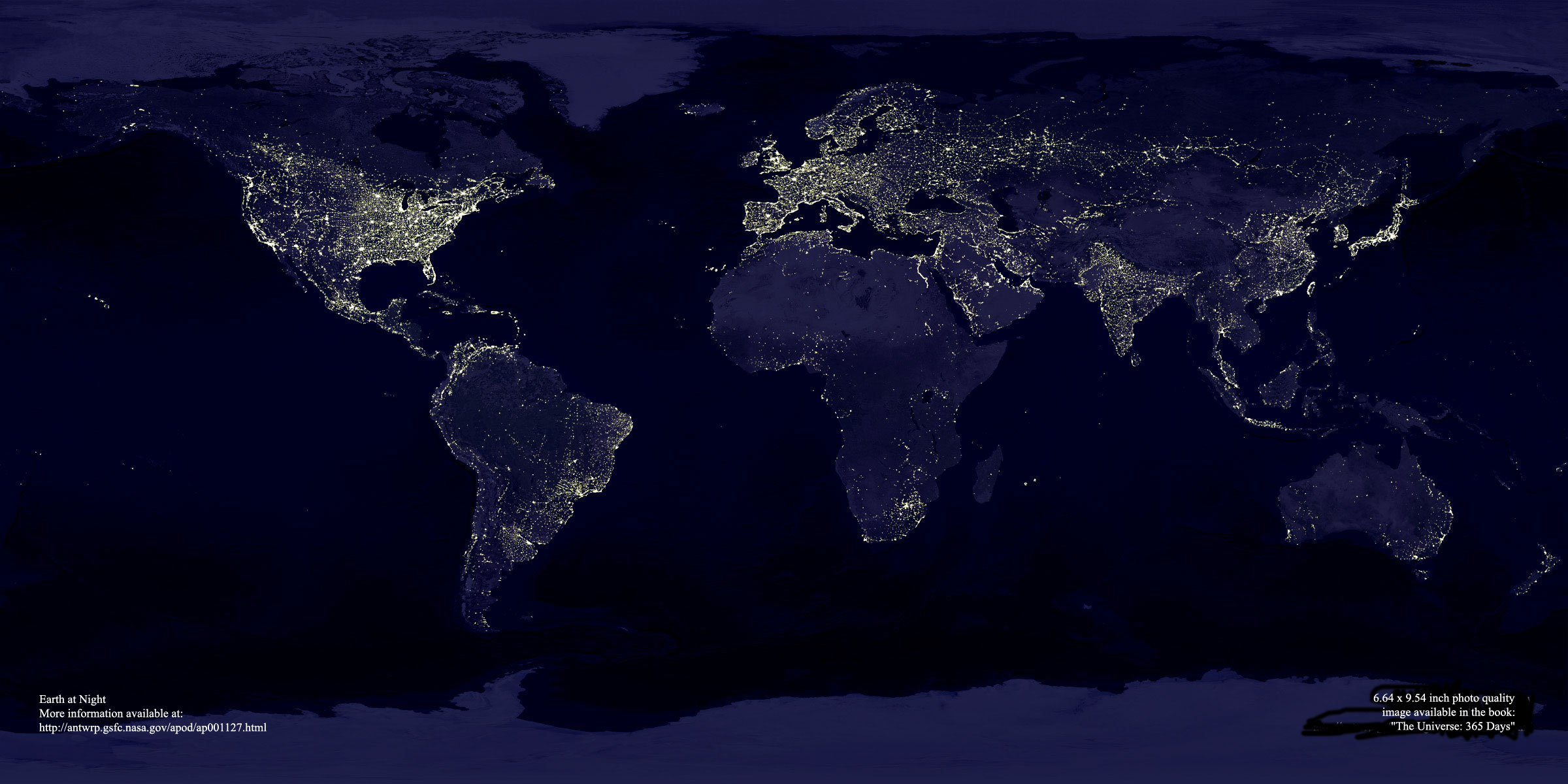
My brother sent me this link years ago, so this picture has been around for a while, but it's still cool. I particularly like the politico-luminary line between North and South Korea - man it must be dark up there. And I still notice new things, like the grid pattern in the American Midwest, and the brilliant tracing of the Nile.
Solar power

I just reported the monthly electric production from the photovoltaic panels we have on our roof. We got these through a Massachusetts program that provided partial grants to cover installation; the grant money gets disbursed over time as the panels produce electricity.
The grants, plus a state tax credit, raise the whole thing from a bad to a mediocre investment, considered purely from a financial perspective. The payoff period is somewhere in the 15-20 year range, although rising electricity rates might shave a couple of years off that.
But no one who has a grid alternative gets into residential photovoltaics for the money. We did it for a couple of different reasons. We have an ideal roof for it - facing almost due south, with no shade, and pitched at roughly 45 degrees, which is more or less optimal for our latitude. It seemed a shame to waste the location. And we're in a pretty solidly middle class, not-especially-sought-after ZIP code, so it's nice to show that solar isn't just for the Brie-and-Prius suburbs.
And then there's the James Bay Cree.
In New England we get a certain percentage of our electricity (I can't find the figure right now, but I think it's around 5-10%) from a huge hydro-power complex in northern Quebec, that was railroaded through over the objections of the Cree Nation, whose hunting grounds got flooded out of existence, and whose fish are now contaminated with mercury, which concentrates in the lakes created by the dams. Needless to say, it's a way more complicated story than that, but the point is there is a cost to our electricity that doesn't get printed on the bill. Our piddly little solar panels don't undo any of the damage, but in some ways it seemed like the least we could do.
Sunday, November 27, 2005
Before there was Google Earth...
This is a much-blogged site, but perhaps worth another mention for the sheer coolness of the concept. The Degree Confluence Project has a goal of visiting every intersection of integer numbered latitude and longitude lines that's on land or within sight of land (e.g., 21 degrees South, 65 degrees West - which happens to be in Bolivia) and taking photographs. Just to see what's there.
It's a very Web project, too: loose affiliation of geography types, with what seem like minimal institutional connections. Anybody with a GPS unit and a camera can contribute.
It's a very Web project, too: loose affiliation of geography types, with what seem like minimal institutional connections. Anybody with a GPS unit and a camera can contribute.
Touchy feely England


I saw this recently in Penzance, England, and it did seem to me that on the other side of the sign people were leaving work early to spend more time with their families.
